
Chemotherapy Price in the Philippines: Cost Per Session and How to Reduce It
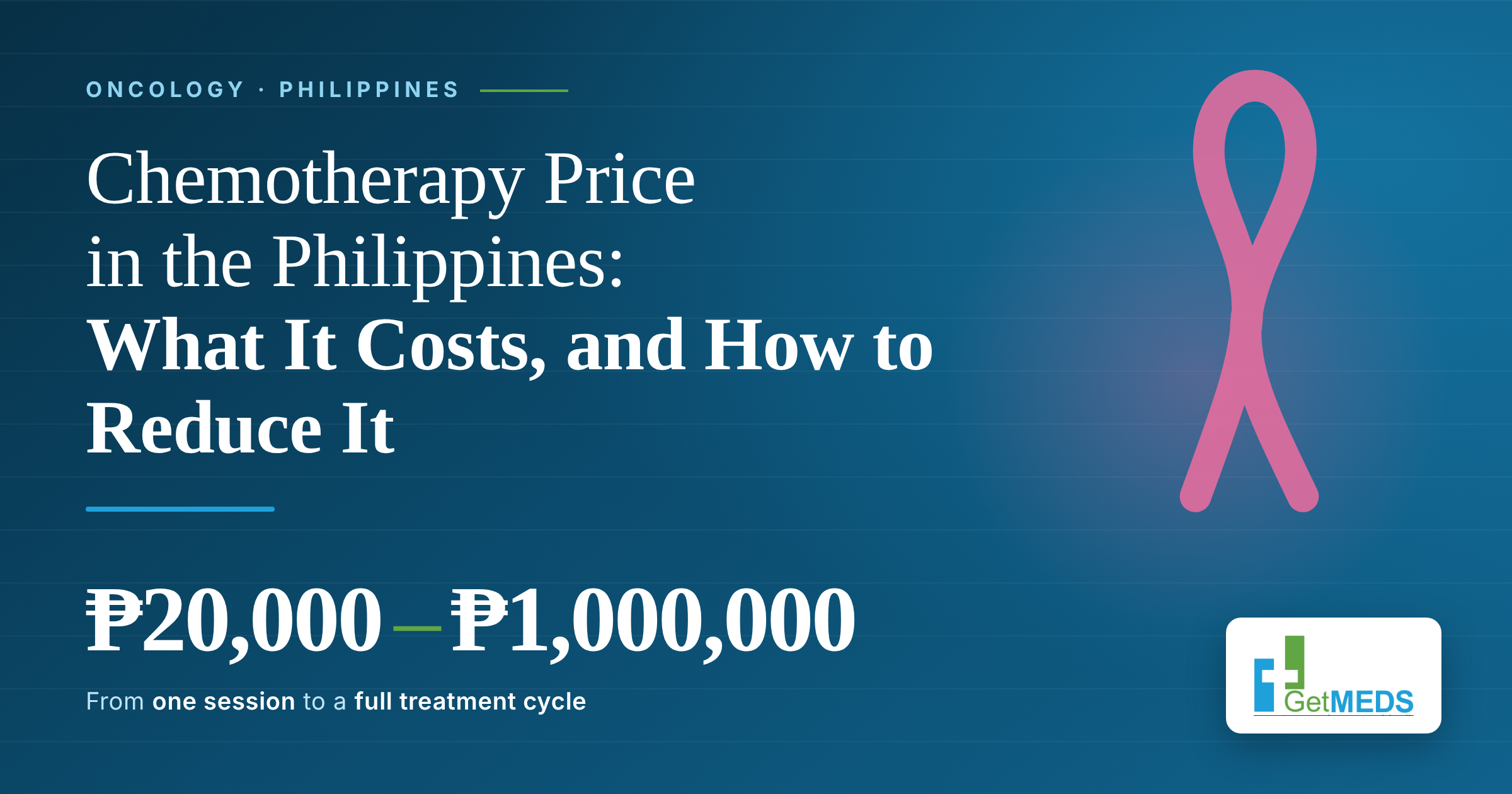
Chemotherapy price in the Philippines starts at around ₱20,000 for a single session, and a full treatment cycle can reach ₱1,000,000 or more, depending on the cancer type, the drugs prescribed, and the number of sessions needed. Government assistance, PhilHealth Z Benefits, and generic cancer medicines can bring this cost down substantially.
Chemotherapy Price in the Philippines: How Much Is One Session?
That ₱20,000 figure comes from costs published in JCO Global Oncology. At the other end of the range, a full treatment cycle can reach ₱1,000,000 — roughly the cost of a complete course of trastuzumab for breast cancer.
The gap between those two numbers is wide because “one session” and “one cycle” are not the same thing. A cycle is the full schedule your oncologist prescribes, and it may run for six, eight, or more sessions over several months. When you are budgeting, ask your doctor how many sessions your protocol requires, not just what one session costs.
One chemotherapy bill usually includes:
- The chemotherapy drugs themselves, which are often the single largest item
- Pre-medications such as anti-nausea and anti-allergy drugs
- Infusion supplies, IV lines, and the chemotherapy chair or room
- Professional fees for the oncologist and the nursing staff
- Laboratory tests before each session to confirm you are fit to proceed
Patients still shoulder a large share of these costs out of pocket. Research by Valerie Ulep, a senior research fellow at the Philippine Institute for Development Studies (PIDS), found that Filipino cancer patients continue to pay a substantial portion of their inpatient treatment even with PhilHealth coverage. For outpatient visits, patients cover about 29% of direct costs, which include treatment, hospital charges, laboratory work, and medicines.
Oral Chemotherapy vs. Intravenous Chemotherapy: What Changes the Price
Oral chemotherapy comes as tablets or capsules taken at home. Intravenous (IV) chemotherapy is infused in a hospital or infusion centre. Both are real chemotherapy, and your oncologist chooses between them based on your cancer and your treatment plan, not on price.
The two are billed very differently.
| Oral chemotherapy | Intravenous chemotherapy | |
|---|---|---|
| Where it is taken | At home, on a schedule | Hospital or infusion centre |
| What you pay for | Mainly the medicine itself | Medicine plus infusion fees |
| Hospital charges | Usually none | Chemotherapy chair or room, IV supplies, nursing |
| Professional fees | Clinic follow-ups only | Per session, plus follow-ups |
| Main cost driver | Price per tablet × tablets per cycle | Drug dose plus facility and professional fees |
Because oral chemotherapy removes the infusion charges, the medicine becomes almost the entire bill. That makes the choice between an originator brand and an FDA-registered generic the single biggest factor in what you pay each cycle.
It also means you can plan ahead. Oral chemotherapy is dispensed per cycle, so you can request a written price quote for your exact prescription — the molecule, the strength, and the number of tablets — before you commit to a refill schedule.
One caution: taking chemotherapy at home does not make it a low-risk medicine. Oral chemotherapy drugs are prescription-only, require regular laboratory monitoring, and carry the same classes of side effects as their IV counterparts. Never adjust your own dose or skip laboratory tests to save money.
Chemotherapy Cost by Cancer Type and What PhilHealth Covers
Chemotherapy costs differ by cancer type because each cancer has its own protocol, its own drugs, and its own number of sessions. The most reliable published figures by cancer type in the Philippines are the PhilHealth Z Benefit packages, which state how much PhilHealth will shoulder for each condition.
| Cancer type | PhilHealth Z Benefit coverage |
|---|---|
| Breast cancer, Stage 0 to IV | Up to ₱1,400,000 |
| Acute lymphocytic leukemia, standard risk | ₱500,000 |
| Rectal cancer, Stage II to III | ₱320,000 to ₱400,000 |
| Colon cancer, Stage II high risk to III | ₱300,000 |
| Cervical cancer, chemoradiation | ₱120,000 to ₱175,000 |
| Colon cancer, Stage I to II low risk | ₱150,000 |
| Prostate cancer, low to intermediate risk | ₱100,000 |
PhilHealth raised the breast cancer Z Benefit package from ₱100,000 to ₱1.4 million and widened it to cover Stages 0 through 4, including patients already undergoing treatment. Package amounts are reviewed periodically, so confirm the current rate with the Z Benefits coordinator at your hospital.
Read these numbers as a floor, not a ceiling. The package is what PhilHealth pays, not the full cost of treatment. Anything beyond the package amount, and any medicine bought outside an accredited facility, remains out of pocket unless another assistance programme covers it.
To qualify for a Z Benefit package you must be a PhilHealth member, be treated in a contracted hospital, and pass pre-authorisation, which can take up to seven working days. Start the paperwork early — before your first session, if you can.
Why Chemotherapy Prices Vary So Much in the Philippines
Six factors move the price more than anything else:
- Cancer type and stage. Later stages usually need more drugs, more sessions, and more supportive care.
- The specific drugs prescribed. Targeted therapies and biologics cost far more per dose than older cytotoxic drugs.
- Originator brand or generic. An FDA-registered generic contains the same active ingredient at the same strength, and usually costs less than the originator brand.
- Number of sessions. Two protocols for the same cancer can differ by several sessions, and each session carries its own fees.
- Public or private facility. Government hospitals generally charge less than private hospitals for the same procedure.
- Your body surface area. Many chemotherapy doses are calculated from height and weight, so two patients on the same protocol can receive — and pay for — different quantities of the same drug.
This is why a general estimate can only take you so far. A written price quote for your exact prescription gives you the one number you can actually budget against.
How the Cost of Cancer Treatment Affects Filipino Families
For most households, cancer arrives on top of existing obligations. According to the American Cancer Society, patients and families facing high treatment costs commonly experience:
- Difficulty meeting daily living expenses
- Having to choose between treatment and household bills
- Delaying medical care for themselves or other family members
- Not refilling prescriptions on schedule
- Spending most or all of their savingsSet featured image
- Taking on additional debt
The National Cancer Institute reports that patients carrying this financial burden tend to have a lower quality of life, with more symptoms, more pain, greater distress, and poorer physical and mental health.
The practical lesson is not to economise by skipping doses. Missed or delayed chemotherapy can reduce how well the treatment works. The safer path is to lower the cost of the same prescribed treatment — which is what the rest of this guide covers.
5 Ways to Reduce the Cost of Cancer Treatment in the Philippines
1. Apply for government medical assistance
Several Philippine agencies shoulder part of a cancer patient’s medicine or hospital bill. Most of them issue a guarantee letter, which the agency pays directly to an accredited supplier or hospital on your behalf.
- DSWD Assistance to Individuals in Crisis Situation (AICS). Covers medicines, hospital bills, and laboratory costs. Applications are filed in person at a DSWD field office, Crisis Intervention Unit, or satellite office — there is no online application for AICS. You will need a medical certificate issued within the last three months and a quotation from an accredited pharmacy or supplier. See our full guide on how to get medical assistance from DSWD.
- PCSO Medical Access Program (MAP). Covers medicines and selected procedures through a guarantee letter. Unlike DSWD, PCSO accepts applications online as well as at its offices. See our guide on how to apply for PCSO medical assistance.
- DOH Cancer Supportive and Palliative Medicines Access Program (CSPMAP). Provides access to selected cancer and supportive-care medicines through DOH-designated facilities.
- Malasakit Centers. A single desk inside participating government hospitals where DOH, DSWD, PhilHealth, and PCSO staff process assistance together, so you do not have to visit each agency separately.
- Office of the President and Office of the Vice President. Both accept requests for medical assistance and issue guarantee letters.
- Philippine General Hospital Cancer Institute. Offers subsidised cancer care for qualified patients.
- SSS and GSIS. Sickness and disability benefits may apply if you are an active or former member.
Also ask your oncologist about non-government help. Foundations such as ICanServe, hospital charity funds, and local government social welfare offices run their own assistance programmes.
2. Maximise your PhilHealth coverage
If you are a PhilHealth member, check whether your cancer has a Z Benefit package and whether your hospital is contracted for it. Pre-authorisation can take up to seven working days, so file early. If you are not yet a member, enrol before treatment starts — coverage cannot be applied retroactively to sessions already paid for.
3. Ask about flexible payment terms
Many hospitals and clinics allow staggered payment or instalment arrangements for chemotherapy. Raise it with the billing or social services department before your first session, not after the bills accumulate. Asking early usually gives you more options.
4. Switch to generic cancer medicines
A generic medicine contains the same active ingredient, at the same strength and dosage form, as the originator brand. Under the Generics Act of 1988 (RA 6675), the generic name must appear on every medicine label sold in the Philippines, so you can always check what you are being dispensed.
Because medicines are often the largest single item on a chemotherapy bill — and nearly the whole bill for oral chemotherapy — switching to an FDA-registered generic is usually the single largest saving available to a patient.
Talk to your oncologist first. Your doctor decides whether a generic version is appropriate for your protocol, and may prescribe by generic name so you can compare suppliers.
5. Get a written price quote before you commit
Prices for the same molecule differ between suppliers. Before you start a cycle, request a written quote for your exact prescription — the generic name, the strength, the dosage form, and the quantity your protocol needs. A written quote also serves as the supplier quotation that DSWD and PCSO require when you apply for a guarantee letter, so one document does two jobs.
Where to Get Generic Cancer Medicines in the Philippines
Getmeds supplies a wide range of generic cancer medicines and chemotherapy drugs in the Philippines — tablets, capsules, injections, and infusion vials — across oncology, hematology, and supportive care, for breast, lung, colorectal, ovarian, prostate, cervical, and blood cancers, with nationwide delivery.
Because these are generic equivalents, they usually cost less than the originator brand. Send us your prescription and we will quote the options available for your molecule, so you can compare prices before you decide. If your oncologist has prescribed by brand name, ask whether a generic equivalent is appropriate for your protocol — we can quote both where both are available.
All cancer medicines are prescription medicines. Send your prescription and we will confirm availability and issue an official written quote for your exact molecule, strength, and quantity. A licensed pharmacist reviews every prescription order before dispatch.
If you are applying for a guarantee letter, that quote is the supplier quotation DSWD and PCSO ask for. Our Patient Assistance Program handles orders backed by a guarantee letter from DSWD, PCSO, the Office of the President, or the Office of the Vice President.
Senior citizens and persons with disability are entitled to the 20% discount and VAT exemption on medicines under Philippine law. Present a valid Senior Citizen or PWD ID when you order.
→ Request a price quote for cancer medicines
→ Apply to the Patient Assistance Program
Frequently Asked Questions About Chemotherapy Cost
How much is chemotherapy per session in the Philippines?
A single session starts at around ₱20,000 based on published figures. The actual amount depends on the drugs prescribed, your dose, and whether you are treated in a public or private facility. Ask your oncologist for your protocol, then request a written quote for the medicines.
How much does a full chemotherapy cycle cost?
A full cycle can reach ₱1,000,000 or more, depending on the regimen. Multiply the cost per session by the number of sessions your oncologist prescribes, then add laboratory tests and supportive medicines.
Is oral chemotherapy cheaper than IV chemotherapy?
Oral chemotherapy avoids infusion and facility fees, so the medicine becomes almost the entire cost. Whether the total is lower depends on the drug prescribed. Your oncologist chooses the route based on your cancer, not on price.
Does PhilHealth cover chemotherapy?
Yes, partly. PhilHealth Z Benefit packages cover specific cancers up to a set amount — for example, up to ₱1.4 million for breast cancer, Stages 0 to IV. You must be treated in a contracted hospital and pass pre-authorisation, which can take up to seven working days.
Is chemotherapy free in the Philippines?
No programme makes chemotherapy entirely free for every patient. However, combining PhilHealth Z Benefits with DSWD AICS, PCSO MAP, DOH CSPMAP, and a Malasakit Center can cover a large share of the cost for qualified patients.
Are generic cancer medicines as effective as branded ones?
An FDA-registered generic contains the same active ingredient at the same strength and dosage form as the originator brand and must meet the same regulatory standards. Your oncologist decides whether a generic is appropriate for your protocol.
Can I buy chemotherapy medicines without a prescription?
No. Chemotherapy drugs are prescription-only in the Philippines. A valid prescription from a licensed Philippine physician is required, and a pharmacist reviews every order before it is dispensed.
Sources
- PhilHealth — Breast cancer Z Benefit package expanded to ₱1.4 million
- PhilHealth Z Benefit packages for cancer patients — package amounts by cancer type
- Philippine Institute for Development Studies — research on out-of-pocket cancer costs
- JCO Global Oncology — published cost figures for chemotherapy in the Philippines
- American Cancer Society — financial impact of cancer treatment on patients and families
- National Cancer Institute — financial burden and quality of life in cancer patients
- ICanServe Foundation — financial assistance programmes for Filipino cancer patients
This article is for general information and does not replace medical advice. Treatment decisions, including the choice between branded and generic medicines, should be made with your oncologist.